
Commercial CCTV guidance
Thermal cameras for business perimeter security
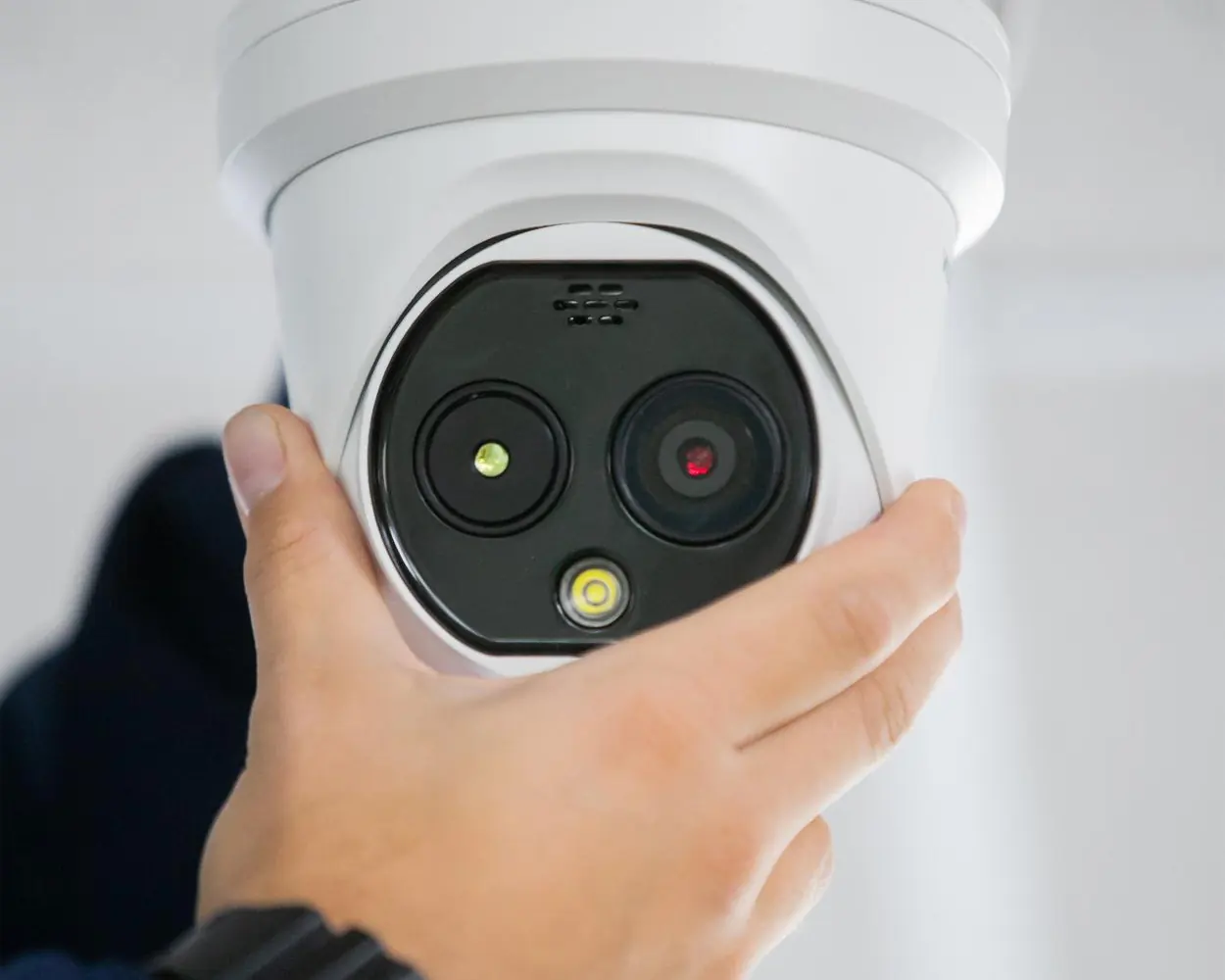
Thermal cameras can reveal people and vehicles through differences in emitted infrared radiation. Their strongest role is often early detection, supported by a separate way to verify what is happening.
- Free site inspection and quotation
- Engineer led, no salespeople
- No callout charges for 3 months after installation
Before you buy
Design for detection, not a recognisable face
A thermal security camera forms an image from infrared radiation rather than relying on visible light. This can make movement stand out where conventional cameras struggle with darkness, uneven illumination or a background that hides a person's clothing.
The resulting image does not usually provide the facial detail or colour information expected from a normal security recording. Seeing a warm shape near a fence is different from identifying the person involved or reading a vehicle registration.
Start by marking where an alert is needed and what action should follow. A thermal proposal should explain the target, distance, environment and verification method, not simply show an impressive picture from a different site.
Set an achievable detection requirement
Separate detection, recognition and identification in the brief. An operator may detect a person at a distance where there are too few pixels to distinguish meaningful features. Ask for the relevant performance assumptions at the actual boundary rather than a single headline range.
Lens choice and sensor resolution determine how much ground appears in the image and how many pixels cover a target. A wide view can sacrifice detail at the far fence. A narrow view may leave gaps or require additional cameras to cover corners.
Consider the target's route and likely concealment. Stacked pallets, parked trailers, vegetation and solid fencing block sight lines. Thermal cameras do not see through walls, and ordinary glass generally blocks the thermal infrared used by typical security cameras.
Understand weather and changing backgrounds
Thermal performance depends partly on contrast between the target and its surroundings. Warm surfaces, changing weather and periods of similar target and background temperature can make detection harder. Do not treat all-hour operation as a promise of identical images in every condition.
Rain, fog and atmospheric conditions can reduce useful range. The extent depends on the equipment, distance and conditions. Ask the designer to explain environmental limitations and demonstrate the proposed distances where practical, rather than describing thermal cameras as weatherproof vision.
Study the background across a full working cycle. Exhaust outlets, heating plant, sun-warmed surfaces and moving vegetation can complicate detection. An empty field demonstration may reveal little about performance beside refrigeration units, loading areas or busy service roads.
Pair detection with useful verification
Plan how an operator will assess an alarm without sending someone into danger. A nearby visible-light camera may provide colour, clothing and wider context, provided lighting and camera positioning support it. Record the limitations of that secondary view after dark.
Some systems can direct a movable camera towards an event, but integration needs testing. Confirm that the view arrives at the right position quickly enough and that other tasks do not leave it pointing elsewhere when verification is needed.
Agree the response process for suspicious activity, authorised work and uncertain events. Thermal analytics produce information for a decision, not a guarantee of intrusion. Clear escalation instructions matter as much as the detection zone drawn on a screen.
Tune analytics to the boundary activity
Set detection areas around the space you genuinely need to protect. Distinguish a person approaching a secure compound from legitimate movement on a neighbouring path. Minimise unnecessary coverage and explain surveillance through appropriate privacy information and signs.
Test crawling, slow movement and approaches from awkward directions where those scenarios are relevant and safe to simulate. Also test normal wildlife or vehicle activity where practicable. Keep a record of settings and the conditions during each acceptance exercise.
Avoid promising that analytics will remove every nuisance alarm. Review event history with the responsible team and adjust carefully, checking that a change intended to suppress false activations does not also hide the movement you need to detect.
Include resilience and specialist maintenance
Check mounting stability, environmental suitability, power arrangements and communications across the perimeter. A long cable run, exposed pole or unreliable radio link can undermine a well-chosen sensor. Ensure faults reach someone able to arrange investigation rather than remaining unnoticed in a status menu.
Follow manufacturer instructions for cleaning and maintenance of the thermal window or lens. Materials and coatings may differ from those on conventional cameras. Improvised cleaning methods can damage surfaces and reduce image quality without an immediately obvious failure.
Revisit the design when storage layouts, fencing or vegetation change. Repeat representative tests in different seasons and keep thermal and verification recordings aligned in time. Specify who owns configuration backups and how replacement equipment will be set up after a fault.
FAQs
Thermal perimeter cameras: frequently asked questions
Can thermal cameras identify intruders?
They can support detection and assessment, but facial identification is generally a separate requirement. Provide a suitable visible-light view at an appropriate location if identifiable images are needed for an investigation.
Do thermal cameras need floodlighting?
Thermal imaging does not depend on visible floodlighting. However, lighting may still be needed for safe movement, staff response and conventional cameras used to verify an event or record identifying detail.
Can perimeter thermal cameras measure body temperature?
Ordinary perimeter security cameras should not be assumed suitable for body-temperature screening. Temperature measurement is a separate application with equipment, calibration and operational requirements that differ from outdoor intrusion detection.
Further reading
Related commercial security guides
PTZ cameras for business sites
A pan tilt zoom camera can inspect different parts of a site and zoom towards activity. Its flexibility is useful, but it cannot record every possible direction at the same time.
Read the guideCCTV recording space
Recorder capacity should follow the recording requirement, not the number printed on a hard drive. Camera streams, recording schedules and realistic retention targets determine how much usable storage you need.
Read the guideUpgrading existing CCTV
An upgrade does not always require replacing everything. Start by identifying what works, what limits the system and which existing assets can support the evidence and security requirements you now have.
Read the guide
Sources
External references used for this guide
Assess thermal coverage at your boundary
MSME Security can discuss thermal detection alongside conventional CCTV during a free site inspection and consultation, helping you define the boundary areas and verification views that need assessment.
Free site inspection
Discuss a thermal perimeter survey
Share the boundary layout, likely approach routes, existing lighting and the action you want an alert to trigger. Include any obstructions or seasonal conditions that may affect the proposed view.
Or email info@msmesecurity.co.uk
- Monday to Friday: 9am to 6pm
- Saturday and Sunday: 11am to 5pm