
Commercial entrance planning
Cantilever vs tracked sliding gates: choosing the right support
Both designs slide across an entrance, but they carry their weight differently. Ground conditions, available runback and daily housekeeping often decide which arrangement is practical.
- Free site inspection and quotation
- Engineer led, no salespeople
- No callout charges for 3 months after installation
Before you buy
Look below and beside the opening
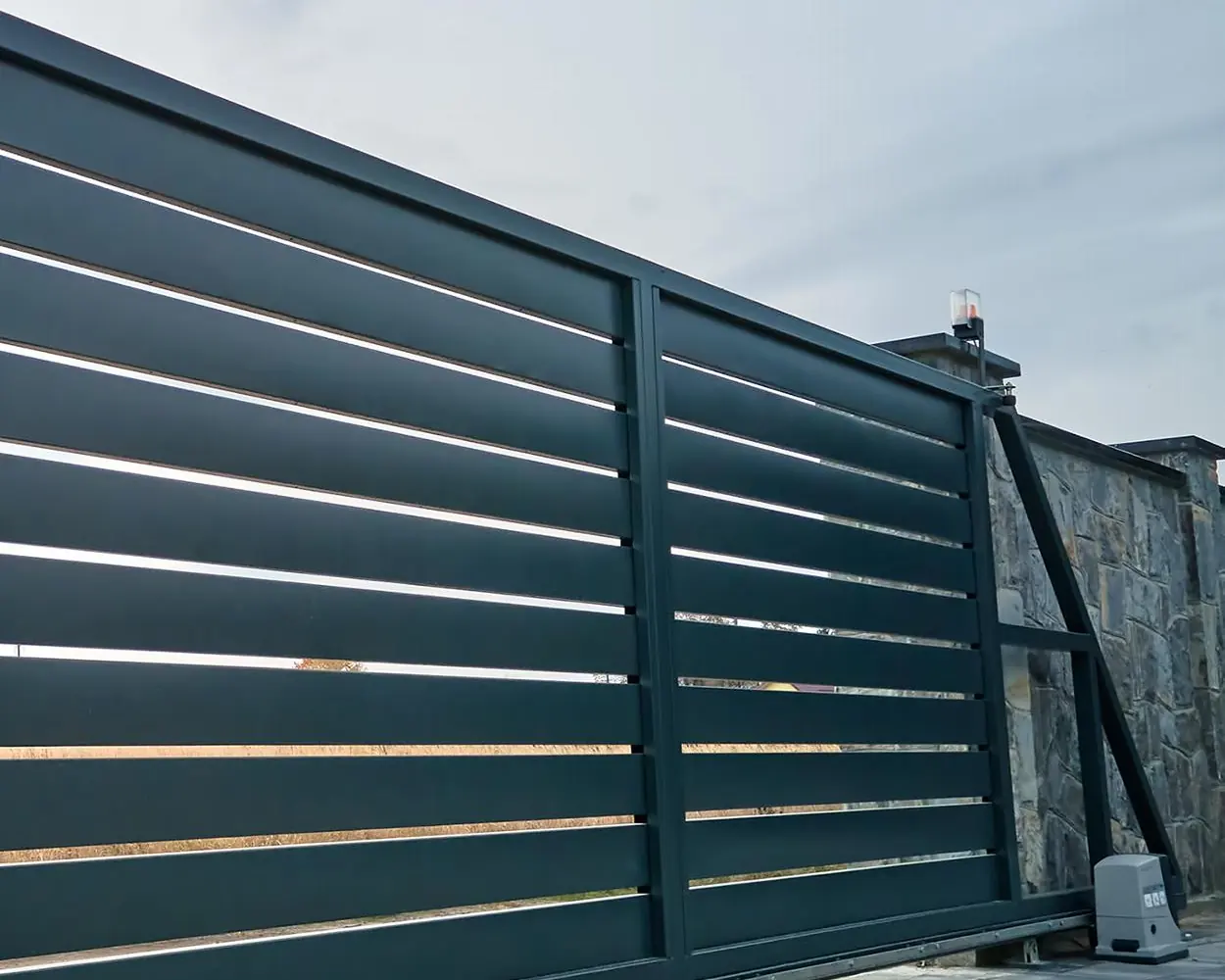
A tracked sliding gate runs on wheels along a rail across the entrance. A cantilever gate is supported by carriages beside the opening, with an extended tail providing the geometry needed to carry the leaf without a ground track across the vehicle route. Neither arrangement is automatically right for every commercial site.
The distinction matters because a clear opening on a plan does not show the whole installation. Both designs need somewhere for the moving leaf to go, suitable support and protection against people reaching hazardous moving parts. A cantilever layout normally needs additional side space for its supporting tail.
Start with a measured survey of the entrance and its surroundings. Identify buried services, drainage channels, changes in level and where vehicles wait. Compare complete layouts rather than selecting a gate from the opening width alone, then discovering that the support arrangement conflicts with the yard.
Compare the full runback envelope
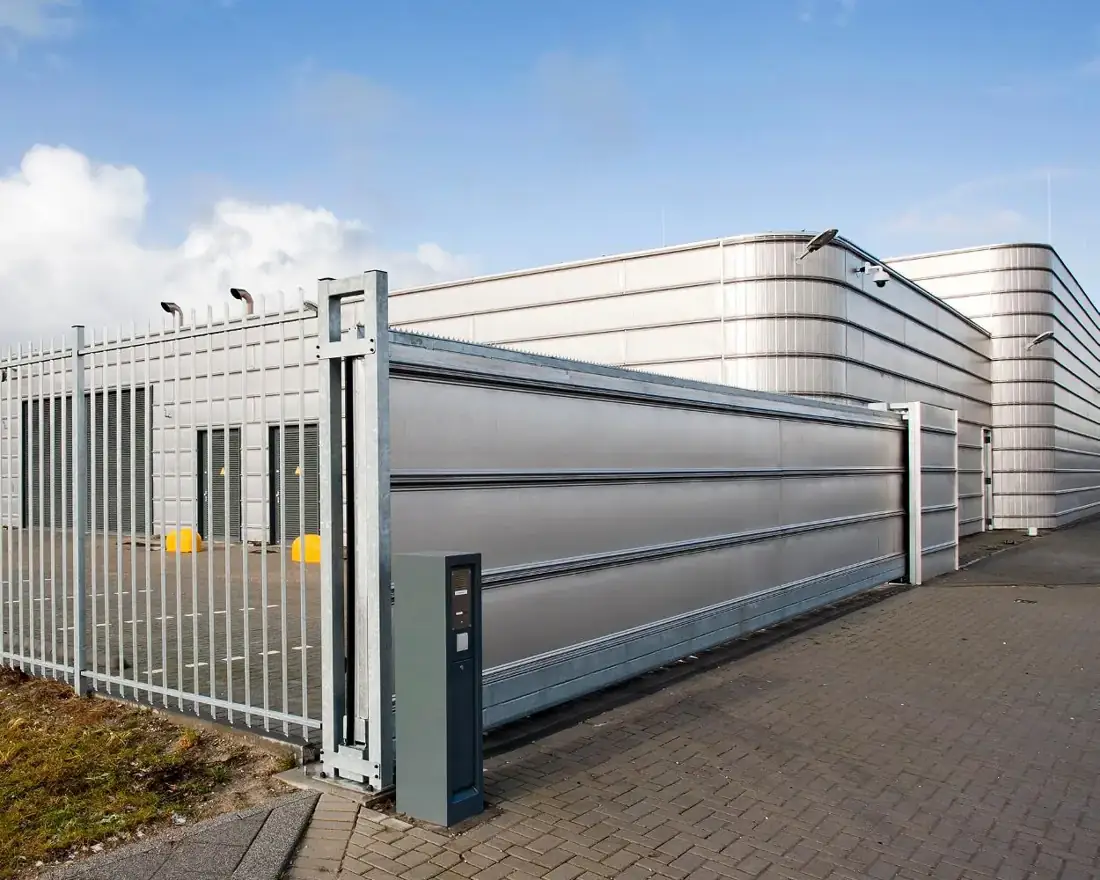
Runback is the space beside the opening occupied as the gate slides away. Measure it with the gate fully open, allowing for stops, support equipment and appropriate guarding. Storage cages, parked trailers or a neighbouring boundary can rule out an otherwise attractive design, even where the entrance itself is wide enough.
A cantilever leaf generally extends beyond the opening to engage its supporting carriages. The exact extra length depends on the engineered design, not a universal allowance. Request a dimensioned drawing showing the complete leaf and foundations. A tracked gate may use less overall leaf length, but still requires an unobstructed travel zone.
Assess the ground and foundation work
Cantilever supports transfer the gate loads into foundations beside the opening. Their design must account for the gate, its movement, wind exposure and local ground conditions. An apparently empty verge is not evidence that suitable foundations can be installed there. Underground services and nearby structures need checking before excavation is agreed.
A tracked arrangement needs a stable, correctly aligned rail and suitable support along its route. Settlement can affect wheel travel and alignment. Discuss the existing surface and vehicle loading with the installer, including whether the proposed civil works will interrupt deliveries. Compare the total construction requirements, not just the visible steelwork.
Plan for dirt, water and winter conditions
A ground rail sits where vehicle tyres, debris and surface water can reach it. Mud, loose stone and compacted material can obstruct travel or accelerate wear. Sites handling aggregates, landscaping supplies or waste should consider how often the rail would need clearing and who could do that safely without entering a live traffic route.
A cantilever design removes the rail across the driveway, which can help where keeping that line clear would be difficult. It does not remove all environmental maintenance. Rollers, guide assemblies and safety equipment still need attention, and drainage must prevent standing water around foundations, motors and electrical equipment. Avoid promises of maintenance-free operation.
Check levels and vehicle clearance
Neither system should be assumed to solve a steep or irregular entrance automatically. The moving leaf needs adequate clearance along its complete travel, and the support design must remain stable. Ask the designer to show the relationship between the gate, changing ground levels and any adjoining footway before finalising the layout.
Check the vehicles that actually use the route, including low trailers and visiting delivery vehicles. A rail crossing, drainage alteration or resurfacing detail may affect clearance and ride quality. Agree how the finished entrance will be made good so that a gate installation does not introduce an avoidable vehicle strike or trip problem.
Protect the travel zone on either design
Sliding gates create hazards beyond the leading edge. People can become trapped or sheared where the moving leaf passes fixed fencing, posts or accessible support equipment. Cantilever support does not make these hazards disappear. Guarding, detection and control measures should follow a site-specific assessment of the complete powered installation.
Keep pedestrian access separate where practicable, and consider approaches from both sides of the boundary. Mesh openings, adjacent steps and gaps under the gate may allow access to moving parts. HSE guidance emphasises the combination of design, protective measures and maintenance. Ask the installer to explain how the rear travel zone is protected.
Compare ownership rather than purchase alone
Request proposals based on the same opening, use pattern and safety requirements. Each should identify foundations, drainage, electrical supply, control equipment and guarding, plus assumptions about existing surfaces. Without this scope, a comparison can mistake omitted civil works for an inherent advantage of one gate design over the other.
Consider future access for inspection and repairs before filling the runback area with permanent equipment. Establish arrangements for clearing debris, reporting collision damage and checking the gate after resurfacing or nearby works. Select the design whose physical demands the site can realistically support throughout its service life, not simply on installation day.
FAQs
Cantilever vs tracked gates: frequently asked questions
Does a cantilever gate need more side space?
Usually it needs additional length beyond the opening for the supporting tail, but the actual dimensions depend on the engineered design. Obtain a full layout drawing rather than estimating from the clear vehicle opening.
Is a tracked gate unsuitable for a busy yard?
Not necessarily. A correctly designed tracked gate can suit commercial use, provided the track, foundations and maintenance arrangements match vehicle movements and site conditions. Heavy debris or settlement risk deserves particular attention during the survey.
Which sliding gate needs less maintenance?
There is no universal answer. A cantilever removes driveway track cleaning, but still has carriages, guides and protective devices to maintain. A tracked gate adds rail and wheel condition to the planned checks. Environment and usage affect both.
Further reading
Related commercial security guides
Automatic gate safety standards
A powered gate is moving machinery, not just a fence panel with a motor. Safety depends on the complete installation, its surroundings and how people can reach it.
Read the guideGate power cuts and backup
When gate power fails, the priority is a predictable, safe entrance. Decide who needs access, how the gate can be released and what remains protected before choosing backup equipment.
Read the guideSwing gate motor types
Choosing a swing gate motor starts with the gate geometry and operating conditions, not appearance alone. The operator must suit the leaf, supporting structure and safety design.
Read the guide
Sources
External references used for this guide
Compare sliding gate layouts on site
Arrange a free site inspection and consultation with MSME Security to assess runback, ground conditions and safe operating space for your commercial sliding gate.
Free site inspection
Discuss your sliding gate entrance
Share the opening width, available space beside it, surface condition and typical vehicles. Mention drainage problems, buried services information and any restrictions on excavation.
Or email info@msmesecurity.co.uk
- Monday to Friday: 9am to 6pm
- Saturday and Sunday: 11am to 5pm